The 1992 Dime Value Guide That Starts With the Big Number

A single 1992-P dime — graded just MS-61 — sold for $1,610 at Heritage Auctions in 2012. That's 16,100× face value, all because of three crisp horizontal bands on the reverse torch. Most 1992 dimes in your pocket change are worth a dime. This guide helps you find out which side of that divide yours sits on.

★★★★★ 4.8 stars · 1,247 collectors rated this tool
Check My 1992 Dime Value →
$1,610
Top auction record (Heritage 2012, MS-61 FB)
1.21B
Total dimes struck in 1992 (P + D)
100×
Value premium Full Bands adds over non-FB
3
PCGS-certified MS-68 Full Bands examples known
$0.10 – $1,610
Full value range
4 issues
P, D, S clad proof, S silver proof
FB
Full Bands = the key to big value
1992
First modern silver proof dime since 1964

Free 1992 Dime Value Calculator

Select your mint mark, condition, and any errors below. The calculator uses documented auction data and PCGS price guide ranges.

Step 1: Mint Mark
Step 2: Condition
Step 3: Special Designations / Errors

If you're not yet sure about your coin's mint mark or condition, there's a 1992 Dime Coin Value Checker free tool where you can upload a photo and get an AI-powered range instantly.

🔍 Full Bands Self-Checker

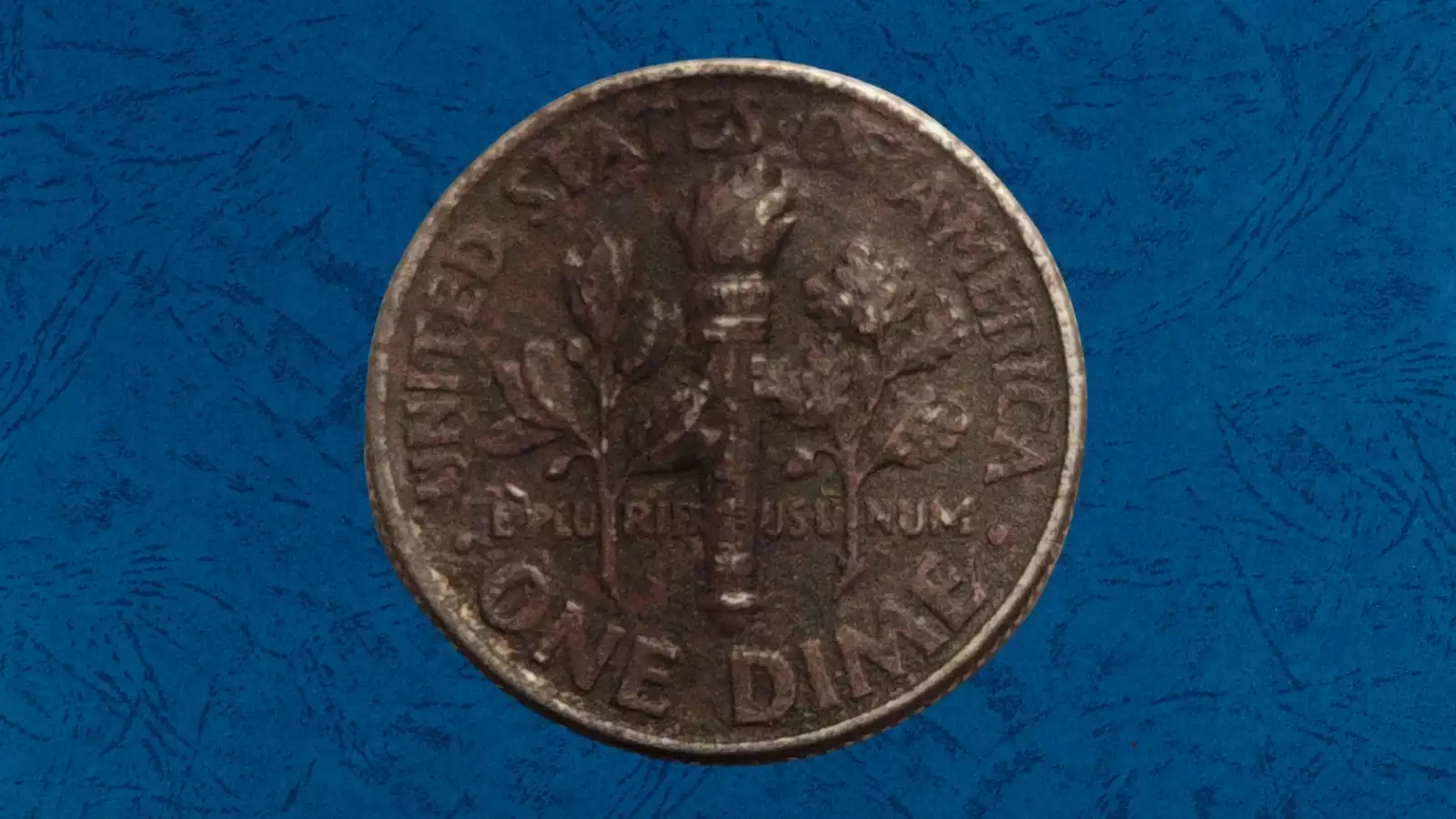
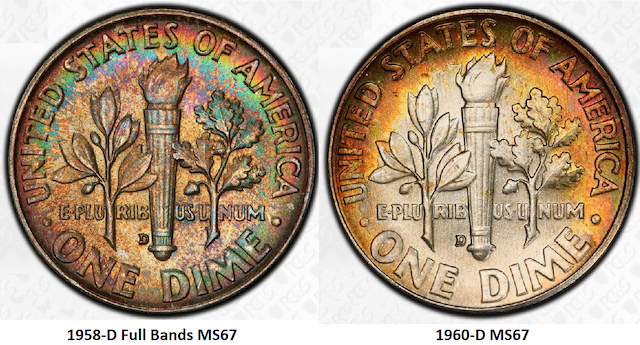
The Full Bands (FB) designation is the single most important factor in 1992 dime value. An MS-61 FB coin is worth more than an MS-67 without it. Use this visual check to see if your coin might qualify.

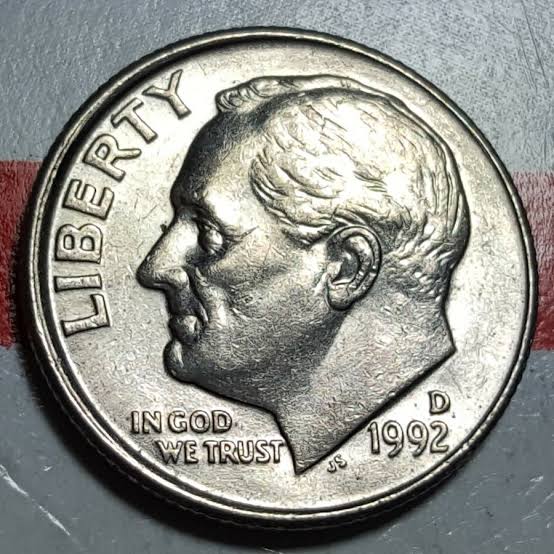
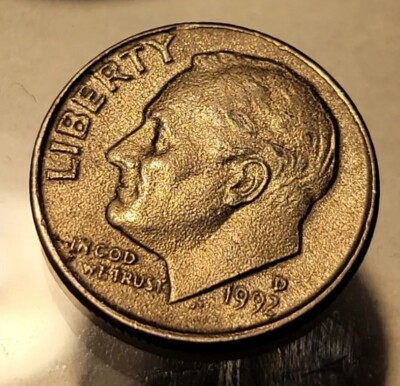
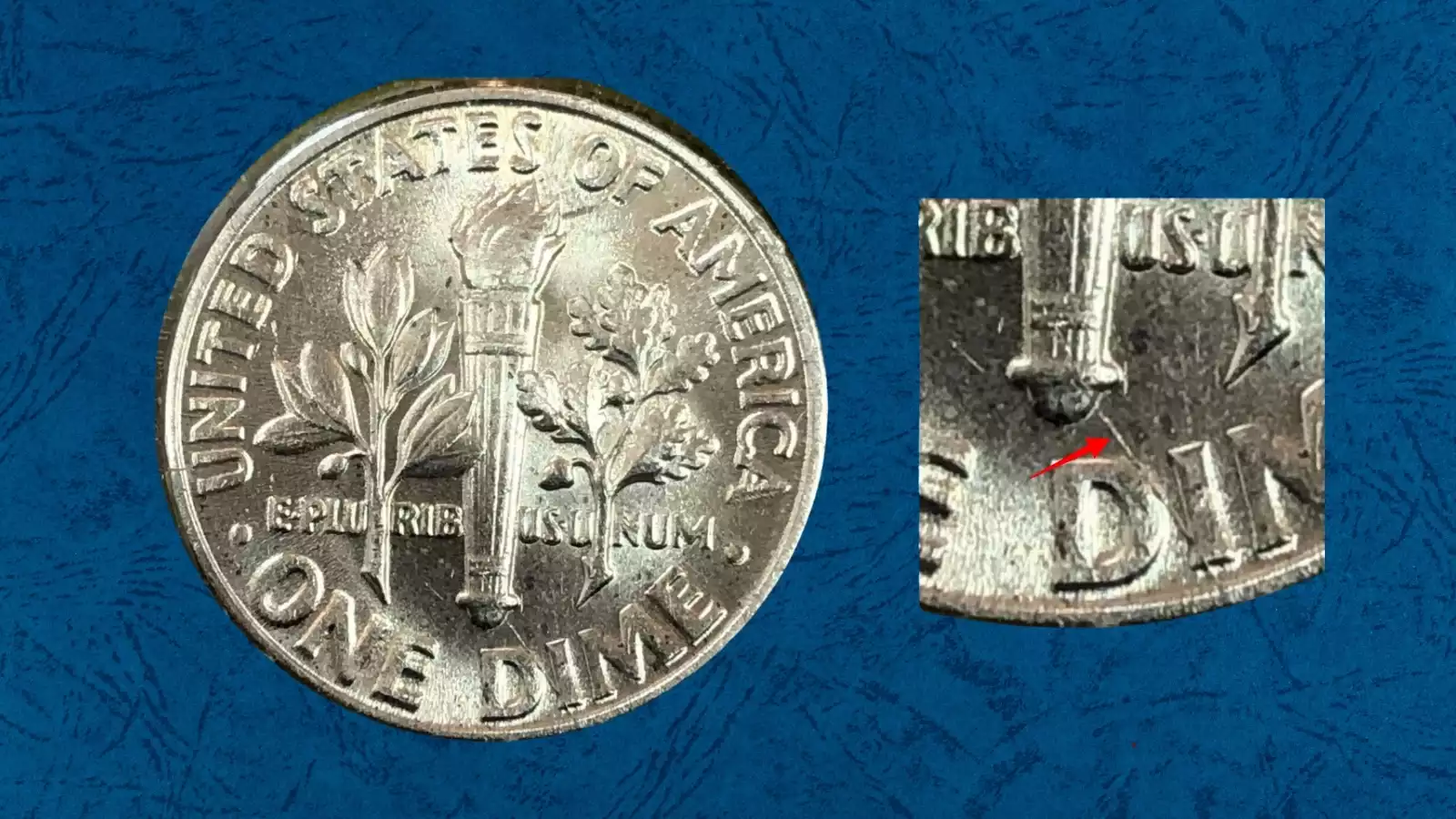
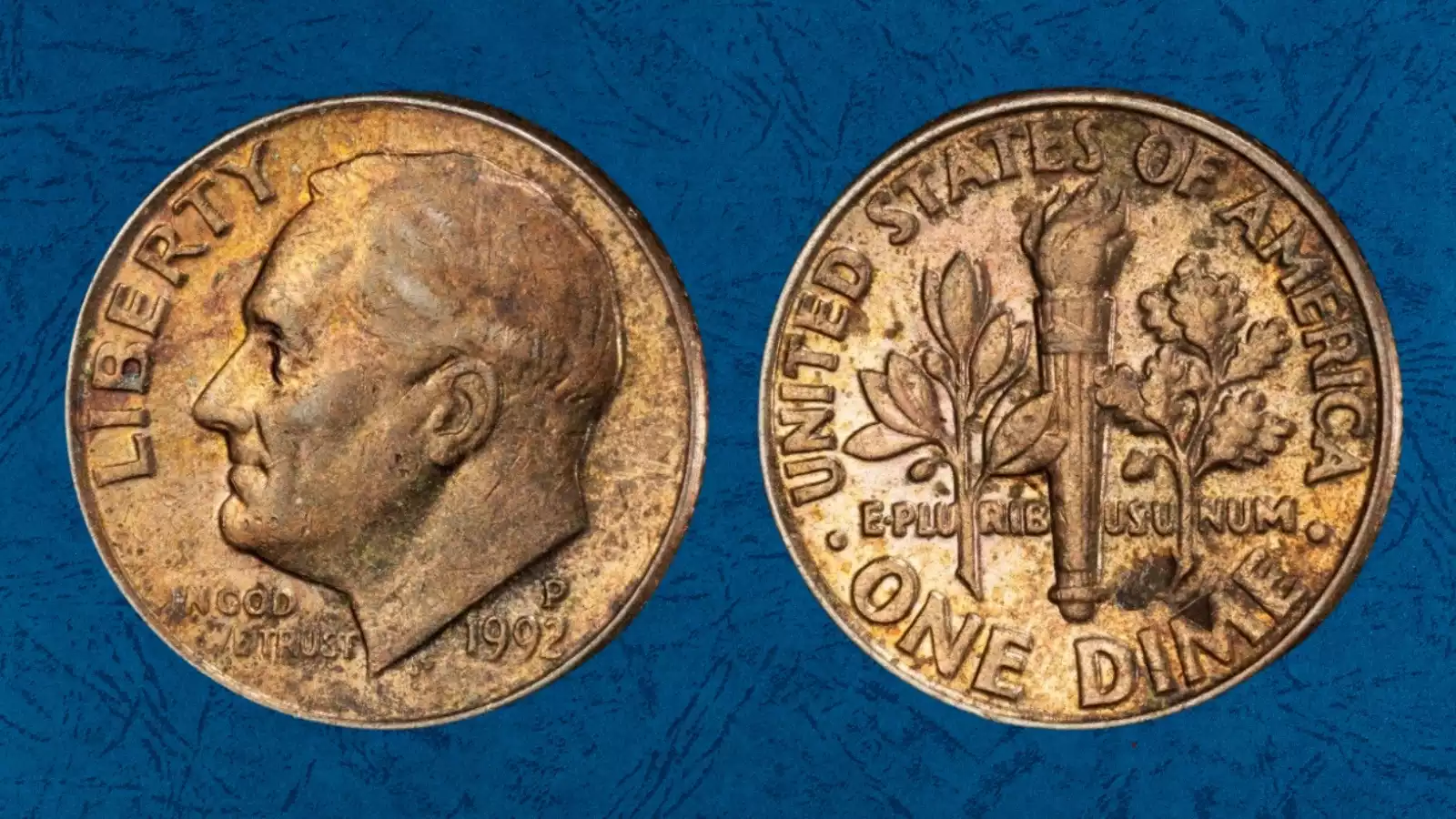
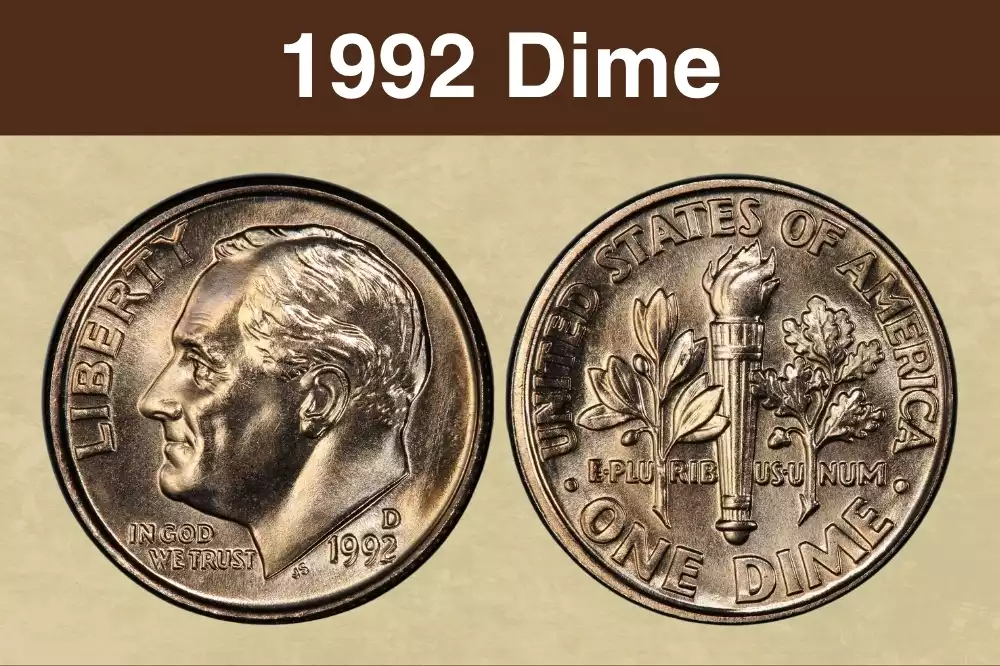
1992-P Roosevelt dime obverse and reverse showing mint mark and torch design
Side-by-side comparison of 1992 Roosevelt dime torch bands: weak non-FB example left vs Full Bands FB example right

⚠️ Common — No Full Bands

Bands appear as a flat, blurry zone where the two horizontal rings merge into each other. No recessed gap is visible between the band pairs. This is the typical result of high-speed production at the Philadelphia and Denver mints in 1992. Value: $0.10 to $350 at MS-68.

✅ Rare — Full Bands

Under a 10× loupe, a clear, dark recessed line (gap) runs between each of the two band pairs on the torch. Both top bands and both bottom bands show complete separation. This crisp strike quality is exceedingly rare on 1992 business strikes. Value: $100 – $1,610+ depending on grade.

Check Your Coin Against These 4 Points

Want a number, not just a yes/no?

The Full Bands check tells you if you have something special. The calculator tells you exactly what it's worth.

Run the Value Calculator →

📋 What's Covered on This Page

Jump directly to the section you need:

The Valuable 1992 Roosevelt Dime Errors (Complete Guide)

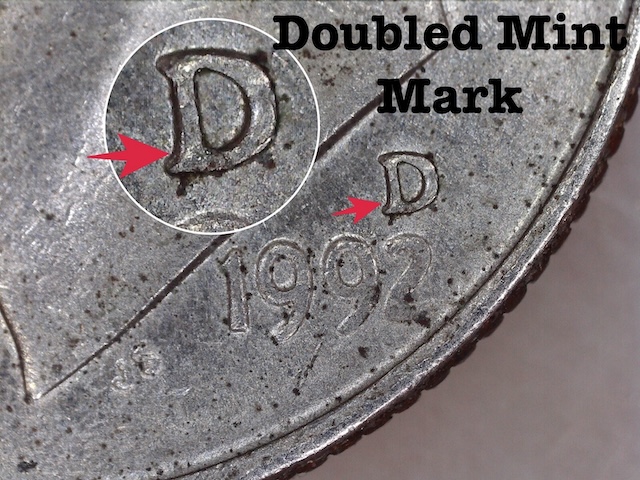
The 1992 Roosevelt dime has no major documented die varieties — no true Doubled Die Obverse, Doubled Die Reverse, or Repunched Mint Mark exists for this date. Mint marks moved to the master die in 1989, eliminating RPMs for all post-1989 issues. What 1992 does offer are genuine planchet and striking errors that can be worth many times face value when dramatically expressed and professionally authenticated. Here are the five most significant ones.

Off-Center Strike Error

MOST FAMOUS $10 – $370+
1992 Roosevelt dime off-center strike error showing design dramatically shifted from center with date visible

An off-center strike happens when a planchet enters the coin press misaligned relative to the dies. Instead of the design landing squarely at center, it is offset — sometimes slightly, sometimes dramatically. The 1992 dime's high-volume production environment meant occasional planchet feed errors reached the striking chamber before operators could catch them.

The value of an off-center strike scales directly with how far off-center the shift is and whether critical design elements survive. A 5–10% shift is barely noticeable and worth only $10–$25. A moderate 20–40% offset raises value to $30–$60. The most desirable examples are 50–80% off-center with the complete date and mint mark still fully visible near the surviving edge — these dramatic specimens have sold for $75–$370 at auction depending on eye appeal and grade.

Collectors prize off-center strikes that tell a clear visual story: you can see exactly what went wrong at the mint. The more extreme the offset, the rarer the coin, because such pieces are more likely to have been caught during production. Authentication by PCGS or NGC is strongly recommended for any example greater than 30% off-center.

How to spot it

Hold the coin flat and look at the edge. The design should be centered within the rim. An off-center coin shows a wide blank area of planchet on one side, with the design (torch, flame, olive branch) pushed toward the opposite edge. Use a loupe to confirm the full date is intact in the surviving rim area.

Mint mark

P (Philadelphia) and D (Denver) business strikes; the high production volume of both mints makes finding these errors possible in pocket change.

Notable

Dramatic examples (50%+ off-center, full date visible) have reached $75–$370 at auction. PCGS and NGC both certify off-center strikes; the population is not tracked separately by degree of offset. Eye appeal and the presence of a complete, readable date are the strongest value drivers at auction.

Double Strike Error

MOST VALUABLE $75 – $1,000+
1992 Roosevelt dime double strike error showing secondary impression of design overlapping the primary strike

A double-struck coin occurs when a struck coin fails to eject properly from the collar and receives a second blow from the dies. Unlike hub doubling (a die-making phenomenon), a double strike is a genuine mechanical production error. The second blow lands slightly rotated or offset from the first, creating a dramatic ghost image layered over the original design.

Visually, double-struck 1992 dimes show two overlapping impressions of Roosevelt's portrait, the date, or the torch reverse — sometimes dramatically displaced, sometimes nearly coincident. When the second strike is far enough from the first that both date areas are readable, the visual drama reaches its peak. The coin's edge may also show a double set of reeding lines where both strikes left their mark at the rim.

Double-struck errors command the highest premiums among 1992 dime errors. A certified 1992-D double-struck example graded MS-63 has reportedly sold for approximately $18,000 in a major auction — establishing double strikes as the premium tier. More typical certified double strikes in lower grades sell for $75–$1,000 depending on strike displacement and grade, with dramatic in-collar double strikes slightly less valuable than out-of-collar examples.

How to spot it

Examine the portrait, date, and lettering under a 5× loupe. A genuine double strike shows a complete secondary raised impression offset from the primary — not just blurring or flat machine doubling. The secondary impression has its own raised relief, not a shelf-like flat extension. Check the edge for doubled reeding as a secondary confirmation.

Mint mark

P and D business strikes; a documented example is the 1992-D double strike, which has appeared at major auction houses in certified holders.

Notable

A 1992-D double-struck example in MS-63 reportedly sold for approximately $18,000 at auction — the highest confirmed sale for any 1992 dime error. PCGS and NGC both certify double-struck examples. Certified population is very small; even lower-grade examples are considered significant finds given their genuine rarity among modern clad issues.

Missing Clad Layer Error

MOST VISUAL $20 – $200
1992 Roosevelt dime missing clad layer error showing copper core exposed on reverse with orange-brown coloration

Business-strike 1992 dimes are copper-nickel clad coins: a pure copper core sandwiched between two outer nickel-copper alloy layers. Occasionally a planchet blank exits the rolling mill with one outer layer missing before it ever reaches the coin press. When such a defective planchet is struck, the resulting coin has one normal silver-colored face and one distinctly orange-brown copper-colored face where the missing layer exposes the copper core.

The missing layer side shows the design normally (the dies pressed the design into the copper core regardless of the missing outer layer), but the color betrays the error immediately. Under magnification, the exposed copper face may also show slight texture differences — the outer surface is softer and the die impression may appear slightly shallower on that side than on the properly clad face.

Missing clad layer errors are among the easiest 1992 dime errors to authenticate without special equipment — the color contrast is immediately obvious in hand. Values range from $20 for single-layer missing examples in worn condition up to $200 for a dramatically expressed missing layer in high uncirculated grades. Coins missing both outer layers simultaneously — leaving only the copper core — are far rarer and command substantial additional premiums beyond the single-layer range.

How to spot it

Tilt the coin under normal indoor light and compare both faces side by side. The normal face is silver-white (nickel-copper alloy); the error face appears distinctly orange-brown (exposed copper core). The color difference is visible without any magnification tools and persists under different lighting angles, ruling out surface toning or staining on a normal coin.

Mint mark

P (Philadelphia) and D (Denver) clad business strikes; this planchet production error can occur at either mint, originating in the rolling strip before blanking.

Notable

Single missing outer clad layers typically reach $15–$200 at auction. PCGS and NGC certify these as "Missing Clad Layer" with the affected side noted (obverse or reverse). Coins with both layers absent are far rarer and would command significantly higher premiums. Authentication is essential — artificially stripped coins (chemically etched) can mimic the appearance but lack the structural characteristics of genuine mint errors.

Wrong Planchet Strike

RAREST $500+
1992 Roosevelt dime struck on wrong cent planchet showing dime design on copper-colored smaller diameter blank

Among all 1992 dime errors, wrong planchet strikes stand apart as the most spectacular and the rarest. These occur when a planchet intended for a different denomination — most commonly a Lincoln cent blank — enters the dime striking chamber. The dime dies then impress the Roosevelt dime design onto an incorrectly sized and composed planchet, creating a hybrid that is clearly neither a proper dime nor a proper cent.

A 1992 dime struck on a cent planchet is instantly recognizable: the coin is copper-colored (cents are 97.5% zinc with copper plating in this era, or earlier all-copper), and the design from the dime dies appears compressed or overflowing the smaller-diameter planchet depending on the exact planchet size. Roosevelt's portrait, the date, and the torch design all appear, but the proportions and size are clearly wrong for a standard dime. The edge may be plain (no reeding) since cent planchets are smooth-edged.

Wrong planchet strikes are genuine collector showpieces. Values start at approximately $500 for a dime-on-cent planchet example in mid-grade and can climb significantly higher for choice uncirculated examples or dramatically compelling mating combinations. PCGS and NGC certification is absolutely essential — these coins must be weighed and measured to confirm the planchet identity, which is documented on the certified holder's label.

How to spot it

Check the coin's diameter (should be 17.9mm for a proper dime), weight (2.27g for dime; a cent planchet is lighter at approximately 2.5g for zinc or 3.1g for copper), and color. A wrong planchet coin will be clearly the wrong color or size. Use a precise digital scale — even a small weight discrepancy flags the coin for professional examination.

Mint mark

P (Philadelphia) and D (Denver) facilities; wrong planchet events can theoretically occur at any high-volume mint when planchet bins for different denominations are mis-routed to a press.

Notable

Values for 1992 dime wrong planchet strikes are estimated at $500+ based on comparable wrong planchet strikes in the Roosevelt dime series. These coins are rare enough that individual examples are seldom tracked in population reports. PCGS labels these "1992 10C on [Planchet Type]"; NGC uses similar designation language. Each specimen is unique in its exact characteristics.

Die Break & Die Cud Error

BEST KEPT SECRET $10 – $200
1992 Roosevelt dime die cud error showing raised metal blob at coin rim where die crack connected to the edge

As coin dies age through thousands of strikes per hour, metal fatigue develops hairline fractures that grow over time. These cracks appear as fine raised lines on struck coins — called die cracks — and are the most common die-related error on any high-mintage modern coin including the 1992 dime. When a crack propagates all the way to the edge of the die, a chunk of the die face actually breaks away, creating what numismatists call a "cud."

A die cud produces a distinctive raised blob of metal on the finished coin, occupying the area where the die fragment broke off. Because the missing piece of die left a depression, metal from the planchet flows into that void during striking, creating a raised lump — often completely obscuring whatever design element or lettering occupied that zone. The cud typically appears at the rim, where die metal is thinnest and fatigue concentrates. Interior die breaks (away from the rim) are called retained die breaks and are somewhat rarer, as the die fragment stays temporarily in place.

Die cuds on 1992 dimes represent a budget entry point into error collecting. Minor, small cuds near the rim typically trade for $10–$20. Larger, more dramatic cuds that eliminate significant lettering or design portions command $50–$200 depending on size, location, and grade. Cuds at prominent spots — obliterating part of "LIBERTY" or eliminating a digit of the date — are the most sought-after examples. CONECA maintains die crack records, but 1992-specific die variety attribution for cuds is not comprehensively documented in public databases.
How to spot it

Run your fingertip lightly across the rim and face of the coin. A cud feels like a distinct raised bump or blob, clearly higher than the surrounding field — unlike a scratch or gouge, which would be recessed. Under a 10× loupe at the rim, a cud appears as an amorphous raised mass of metal with an irregular edge, not a clean design element.

Mint mark

P (Philadelphia) and D (Denver) business strikes; with over 1.2 billion combined, even rare die states appear in modest quantities across the mintage.

Notable

Minor die cracks on 1992 Roosevelt dimes sell for $10–$20; dramatic retained die breaks can reach $50–$100. True through-the-rim cuds on this date top out around $100–$200 for dramatic examples in uncirculated grades. CONECA tracks die crack attributions for Roosevelt dimes, though not all 1992 die states have formal catalogue numbers. Compare your coin against the CONECA Master Die Variety (MDV) listings.

1992 Roosevelt Dime Mintage & Survival Data

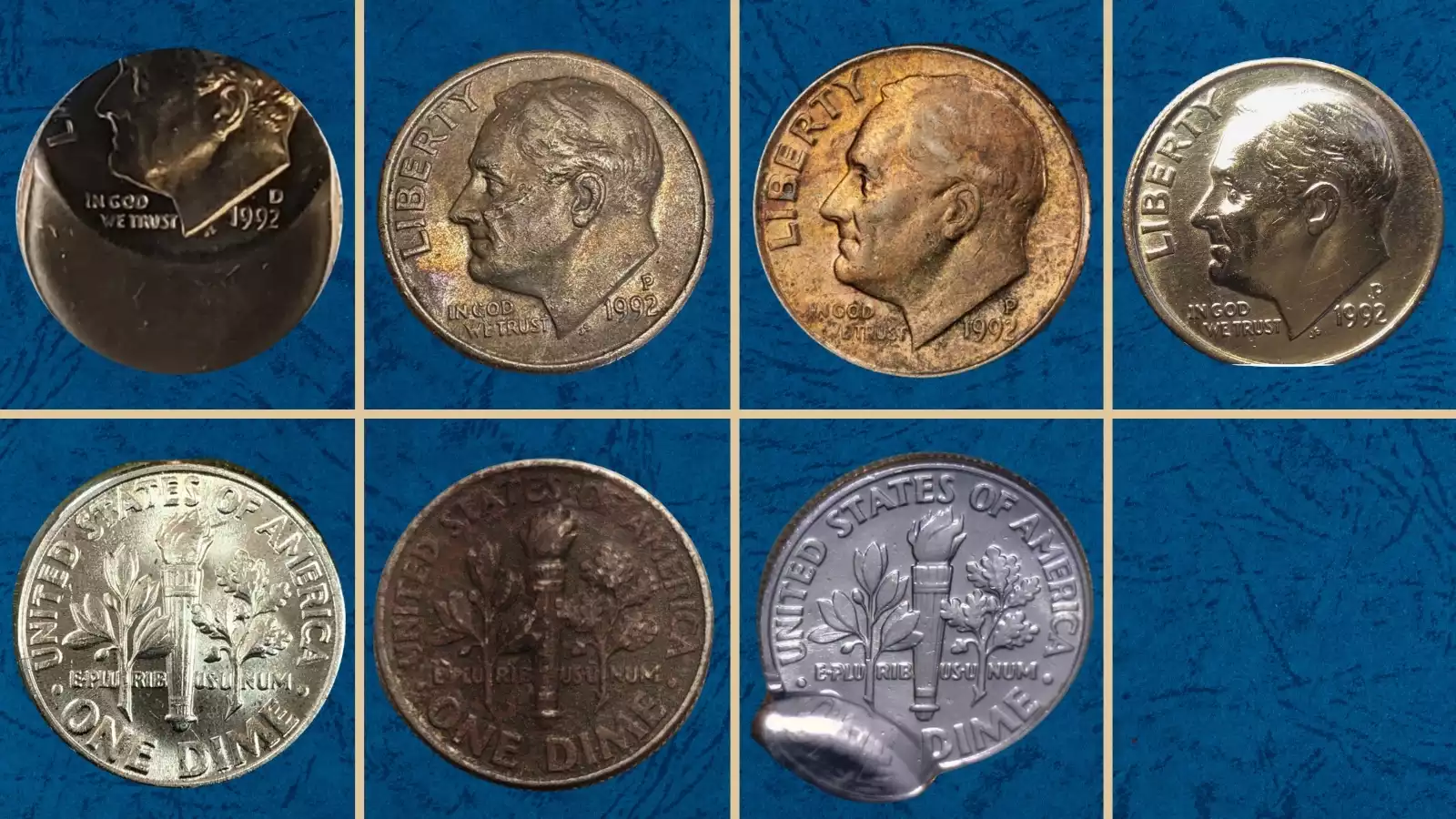
Group of 1992 Roosevelt dimes showing various grades from circulated to uncirculated arranged for comparison
Issue Mint Mintage Strike Type Circulated Value Uncirculated Value
1992-P Philadelphia 593,500,000 Business Strike $0.10 – $0.35 $2 – $350 (MS68)
1992-D Denver 616,273,932 Business Strike $0.10 – $0.35 $2 – $192 (MS68)
1992-S (Clad Proof) San Francisco 2,858,981 Proof (Clad) N/A $3 – $18 (PR70 DCAM)
1992-S (Silver Proof) San Francisco 1,317,579 Proof (Silver) N/A $6 – $23 (PR70 DCAM)
Total 1992 Production ~1,213,950,492 All issues combined
Composition note: The 1992-P and 1992-D dimes are copper-nickel clad: 75% copper / 25% nickel bonded over a pure copper core. Weight: 2.27 g. Diameter: 17.90 mm. Edge: reeded. Designer: John R. Sinnock (JS initials on neck truncation). The 1992-S Silver Proof uses 90% silver / 10% copper, weighing approximately 2.50 g — the first modern silver proof dime issued since 1964.

Survival rates: With over 1.2 billion struck, virtually all 1992 dimes survive in some grade. Condition rarity begins at MS-68 for standard examples. True survival rarity applies only to the Full Bands designation — PCGS reports just 3 examples at MS-68 FB, with NGC showing 12 at that level and one unique MS-69 FB specimen in the NGC registry.

Found one of these errors on your coin?

Run it through the calculator to get a specific value estimate for your mint mark, grade, and error combination — or describe it in your own words below.

Get My Error Coin Value →

Describe Your 1992 Dime for a Detailed Assessment

Not sure how to grade your coin? Type what you see and the tool will analyze your description and return relevant value guidance.

Mention these things if you can

  • Mint mark (P, D, or S)
  • Whether it appears uncirculated or worn
  • Torch band detail (sharp, separated, blurry)
  • Any color anomalies (copper showing through)
  • Surface marks, scratches, or cleaning

Also helpful

  • Coin's luster quality (bright, dull, toned)
  • Any off-center or misaligned strike
  • Edge condition (full reeding, missing reeding)
  • Weight (if you have a digital scale)
  • Whether the coin is in a holder

1992 Dime Value Chart at a Glance

The table below consolidates pricing from PCGS CoinFacts, Heritage Auctions, and GreatCollections results. For a complete illustrated step-by-step 1992 dime identification guide with grading photos, the linked resource covers every grade tier in detail. The highlighted row (gold) marks the Full Bands signature variety; the red-highlighted row marks the rarest single error (wrong planchet).

Issue / Variety Worn / Circ. Fine – XF Unc. (MS60–67) Gem MS68+
1992-P (no FB) $0.10 – $0.15 $0.20 – $0.35 $2 – $22 $350 (MS68)
1992-P Full Bands (FB) $100 – $1,610+ Very rare, est. $5,000+
1992-D (no FB) $0.10 – $0.15 $0.20 – $0.35 $2 – $18 $192 (MS68)
1992-D Full Bands (FB) $50 – $449+ $425 (MS67FB)
1992-S Clad Proof $3 – $10 $18 (PR70 DCAM)
🔴 1992-S Silver Proof $6 – $15 $23 (PR70 DCAM)

🪙 CoinKnow lets you cross-check your coin's condition against certified examples in seconds, right from your phone — a coin identifier and value app.

How to Grade Your 1992 Roosevelt Dime

Grading a 1992 Roosevelt dime means assessing wear on specific high points and evaluating luster quality. For most 1992 dimes, the difference between circulated and uncirculated determines whether your coin is worth $0.10 or $7. For Full Bands coins, the difference between MS-65 FB and MS-67 FB can be thousands of dollars.

1992 Roosevelt dime grading strip showing four condition tiers from worn to gem uncirculated in a horizontal row

Worn (G–VG)

Heavy wear flattens Roosevelt's cheek, jaw, and most hair detail. The torch flame tips merge into flat areas. Date and lettering remain readable but may be weak. Value: $0.10 at face value. These coins are bullion-grade at best.

Fine – XF (F–EF)

Moderate to light wear on Roosevelt's cheek and high-point hair. Torch flame outlines survive but interior lines are soft. All lettering and date are sharp. Value: $0.20–$0.35. Still essentially face value for 1992 dimes.

Uncirculated (MS60–67)

No wear anywhere — but look for bag marks on Roosevelt's cheek and temple. Luster should show a full cartwheel effect when tilted under light. Value: $2–$22 without FB; $100–$1,610+ with Full Bands depending on grade.

Gem MS68+

Virtually perfect surfaces with minimal contact marks, bright original luster, and full strike sharpness across all design elements. Only a handful of 1992 dimes reach this level. Value: $192 (D) to $350 (P) without FB. Near-unique with FB at this level.

Pro tip — Luster & Strike: For 1992 dimes, luster quality alone won't push a coin into the top tier without a strong strike. When assessing your coin for FB potential, examine the torch under magnification before evaluating surface marks — a coin with pristine surfaces but flat bands has far less value than a heavily contact-marked coin with perfect band separation. NGC uses the "Full Torch" (FT) designation while PCGS uses "Full Bands" (FB); both require the same visual standard of complete band separation at both the top and bottom band pairs.

📱 CoinKnow helps you match your coin's surface to graded examples in its database, giving you a fast condition reference on the go — a coin identifier and value app.

Where to Sell Your Valuable 1992 Dime

The right venue depends heavily on what you have. A common circulated 1992-P barely justifies postage. A Full Bands coin or a dramatic error needs the right audience to realize its potential.

🏆 Heritage Auctions

The proven venue for Full Bands 1992 dimes and dramatic error coins. Heritage's January 2012 auction produced the all-time record $1,610 sale for the 1992-P MS-61 FB. Their numismatic specialists attract serious collectors willing to pay premium prices for certified coins. Best for coins worth $100+.

🛒 eBay

Excellent for mid-range uncirculated examples and certified slabs. Browse recently sold prices for 1992 Roosevelt dimes with completed auction results to calibrate your asking price before listing. eBay's global buyer pool helps for scarce varieties. Use "Buy It Now" for certified slabs and auction format for errors where bidding competition drives prices up.

🏪 Local Coin Shop

Best for immediate cash on common circulated examples. Dealers typically offer 50–70% of retail for common coins — which on a $0.10 dime is trivial. But for a coin you suspect has Full Bands, skip the local shop and get it certified first. Local dealers may not recognize the premium; a PCGS or NGC holder makes the value undeniable.

💬 Reddit (r/Coins4Sale)

Strong community for collector-to-collector sales of certified coins. A PCGS or NGC holder with Full Bands designation sells itself — the community understands exactly what they're looking at. Fees are minimal, but transaction volume is lower than major platforms. Good for coins in the $50–$300 range where Heritage auction fees would take a large percentage.

💡 Get it graded first: Any 1992 dime that appears uncirculated with possibly sharp torch bands should be submitted to PCGS or NGC before selling. The certification fee is modest compared to the premium a genuine Full Bands coin commands. Even if it doesn't earn FB, a certified MS-67 holder demonstrates authenticity and condition objectively to buyers everywhere.

Frequently Asked Questions About 1992 Dime Value

How much is a 1992 dime worth?

Most circulated 1992 dimes (P or D mint mark) are worth $0.10–$0.35, barely above face value. Uncirculated examples without Full Bands trade for $2–$7 in common grades. Gems at MS-68 have reached $192–$350 at auction. The real prize is the Full Bands designation: a 1992-P MS-61 FB sold for $1,610 at Heritage Auctions in January 2012, the record for any 1992 business-strike dime.

What is the Full Bands designation and why does it matter for 1992 dimes?

Full Bands (FB) — or Full Torch (FT) at NGC — means both pairs of horizontal bands on the reverse torch show complete separation with a visible recessed line between them. High-speed production in 1992 caused most dimes to exit the press with soft, blurry torch bands. Coins showing crisp Full Bands are exceptionally rare, commanding 10–100× the value of non-FB examples in the same numerical grade.

What is the 1992-P dime auction record?

The highest confirmed auction record for a 1992-P business strike dime is $1,610, achieved at Heritage Auctions in January 2012 for an example graded MS-61 FB by PCGS. This sale demonstrates that strike quality (Full Bands) matters far more than surface preservation for this date. The standard 1992-P without FB reached $350 for an MS-68 specimen sold on eBay in August 2018.

What are the mintage figures for 1992 dimes?

Philadelphia struck 593,500,000 dimes; Denver struck 616,273,932 — a combined circulation total of more than 1.2 billion. San Francisco produced 2,858,981 clad proof dimes and 1,317,579 silver proof dimes. Despite the enormous production run, Full Bands examples are extremely scarce because mass production at high speeds inevitably left most coins weakly struck at the torch bands.

Is there a 1992 dime silver version?

Yes. The 1992-S Silver Proof dime, struck at San Francisco in 90% silver, was the first modern silver proof dime issued since 1964. With a mintage of only 1,317,579, it is sold exclusively in special Silver Proof Sets. In Deep Cameo proof condition, these typically bring $6–$23 depending on grade, with PR-70 examples reaching higher premiums at auction.

Are there any valuable 1992 dime errors?

Yes, though 1992 has no documented major die varieties (no true DDO/DDR or RPM). Valuable errors include dramatic off-center strikes with the full date visible ($75–$370+), double-struck coins ($75–$1,000+), missing clad layer errors that expose the copper core ($20–$200), and wrong-planchet strikes ($500+). Professional authentication by PCGS or NGC is essential before any error premium is assumed.

How do I tell if my 1992 dime has Full Bands?

Flip the coin to the reverse and examine the torch. Two sets of horizontal bands wrap around the torch — one pair near the top, one pair near the bottom. Under a 10× loupe, look for a clear recessed line (gap) running between each pair of bands. If both pairs show complete separation, the coin qualifies for Full Bands. Weak strikes show the bands touching or merging into a flat, blurry area.

What is the composition of a 1992 Roosevelt dime?

Business-strike 1992 dimes (P and D) are clad coins: 75% copper and 25% nickel bonded over a pure copper core. Weight is 2.27 grams; diameter is 17.90 mm; edge is reeded. The 1992-S Silver Proof is 90% silver and 10% copper, weighing 2.50 grams. Designer is John R. Sinnock, whose initials 'JS' appear on Roosevelt's neck truncation.

Where can I sell a valuable 1992 dime?

For Full Bands examples or significant errors, Heritage Auctions provides the widest collector audience and the best documented results. eBay is excellent for mid-range examples with photo evidence. A local coin shop offers immediate payment but typically lower offers. Reddit's r/Coins4Sale community is good for certified coins where the PCGS or NGC holder speaks for itself. Always get Full Bands examples certified before selling.

Should I clean my 1992 dime before selling?

Never clean a coin. Cleaning destroys the original mint luster that grading services use to assess surface quality. A cleaned 1992 dime will receive a 'details' grade from PCGS or NGC, permanently lowering its value and collectability. Even a coin that looks dull or spotted is worth more uncleaned than one with bright, polished surfaces — cleaning marks are visible under magnification and never go away.

Ready to find out what your 1992 dime is worth?

Use the free calculator — it takes 30 seconds and covers all four 1992 issues including Full Bands premiums and error values.

Check My Coin's Value Now →